
1
Discover Filings
Congress Radar ingests official public disclosures and keeps source links attached to every public item.
Congress Radar helps you follow official House and Senate financial disclosures, filing delays, lawmaker profiles, issuer pages, and price context where reliable public market data exists.
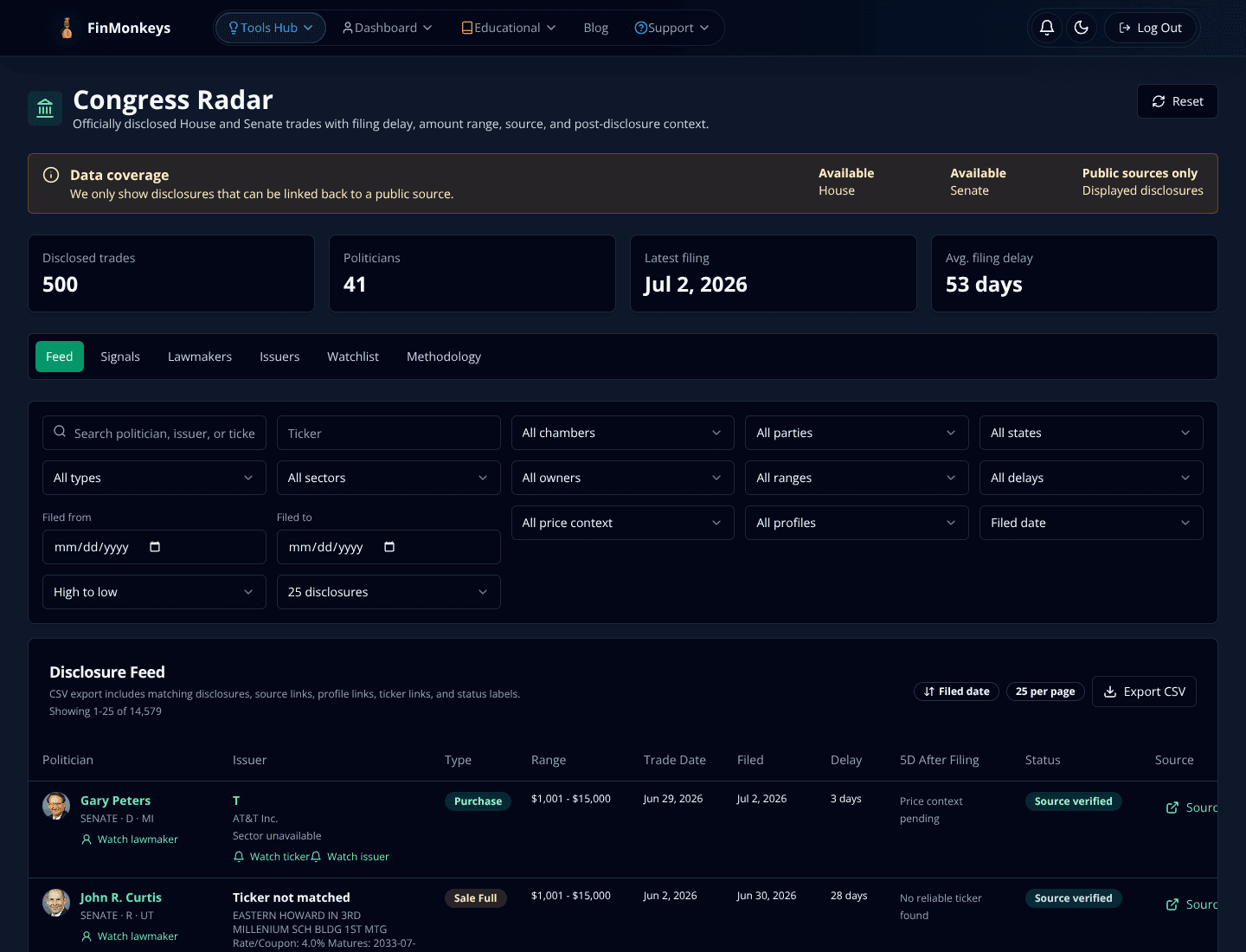
A clean workflow for understanding disclosed activity without pretending delayed filings are real-time trade alerts.
Congress Radar ingests official public disclosures and keeps source links attached to every public item.
Filter by chamber, lawmaker, party, ticker, transaction type, filing date, and disclosure timing.
Use member profiles, issuer pages, delay metrics, and price context as research evidence, not trading instructions.
Start with the disclosure feed, then open source filings, lawmakers, and issuers without leaving the research workflow.
Scan official filings by chamber, lawmaker, ticker, transaction type, date, and amount range without losing the public source behind each disclosure.
Senate disclosures appear when official filings are processed. Missing ticker or price context is labeled clearly instead of hiding source-backed filings.
Open matched lawmakers and tickers to review repeated issuers, filing timing, source-backed tables, and price context where reliable market history exists.
Congress Radar turns scattered official filings into a cleaner, source-linked research workflow.
Useful for users who care about source evidence, timing, and clear data limitations.
Monitor disclosed lawmaker activity alongside the filing date and public source instead of treating delayed disclosures as live signals.
Move faster from a filing to the source document, linked lawmaker profile, ticker page, and disclosure history.
See clear labels when a filing is source-limited, a ticker is not reliable, or market history is not enough for price context.
Congress Radar is designed around evidence: public source links, filing dates, amount ranges, chamber filters, and clear limitations when context is unavailable.
Read Methodology ->"The important part is seeing the source, filing delay, and amount range together. It changes how we interpret each disclosure."
"A missing ticker should not make a filing disappear. Congress Radar keeps the disclosure visible and explains the limitation."
"Member and issuer pages make follow-up research faster because the feed links directly into the context users naturally need next."
"The important part is seeing the source, filing delay, and amount range together. It changes how we interpret each disclosure."
"The source link is the trust layer. Every disclosure should be easy to trace back to a public filing."
SOURCE-BACKED RESEARCH"Delayed filings need timing context. Congress Radar separates the transaction date from the filing date."
DISCLOSURE TIMINGCongress Radar uses official public disclosure sources for House and Senate filings, then keeps public source links attached wherever a disclosure appears.
No. Congress Radar is a research tool. It shows official disclosure context, filing timing, amount ranges, and source links so users can do their own research.
Price context is shown only when a reliable public ticker and enough market history are available. Otherwise the tool explains the limitation in plain language.
Senate disclosure data is available where official filings have been successfully processed. Congress Radar does not present source-limited data as complete.
Use Congress Radar to track source-backed filings, filing delays, lawmaker activity, issuer history, and price context where reliable data exists.
Professional plan feature. Research only.
Research library
Continue into comparisons, checklists, and guides that help verify recent news, filings, risks, and market context.